Your reference for hepatitis C in Quebec

April 29, 2026 · Quebec Hepatitis C Awareness Day

Open Letter from Laurence Mersilian, General Director of the Centre Associatif Polyvalent d’Aide Hépatite C (CAPAHC) and 41 professionals from the community and health sectors*
The spread of the hepatitis C virus (HCV) is not inevitable. It can—and must—be halted by 2030, in line with the World Health Organization’s targets, just as HIV has been. Yet the Quebec government has been conspicuously absent, both in comparison to other jurisdictions and in response to the numerous calls from community and health sector stakeholders who have been demanding a national strategy to combat hepatitis C for years.
Today, HCV can be treated and cured in 8 to 12 weeks, with very few side effects. Screening for the virus has also been greatly simplified thanks to rapid tests approved by Health Canada, which can detect antibodies using a single drop of blood from a finger prick. Despite this, about one-quarter of those infected are unaware that they are carriers of the virus (Public Health Agency of Canada, 2022).
Given the simplicity of the protocol, rapid screening could easily be carried out by properly trained community health workers. These individuals are already working in STI prevention, possess recognized expertise, and maintain a vital connection with the populations most at risk. This would be a decisive step toward improving access to care and advancing the fight against HCV.
Collaboration with community organizations would also help relieve pressure on the public healthcare system by serving as a first point of entry into a system that is already under significant strain. In reality, the main obstacle for those affected remains access to care pathways—an issue where community support has proven particularly effective.
The community sector is a natural ally in the fight against HCV, just as it has been in the fight against HIV and COVID-19. In fact, the WHO explicitly recommends involving the community sector to improve access to treatment. Yet the Quebec government refuses to move in this direction, arguing that community workers are not qualified to provide “safe” testing.
This refusal is not only absurd, but also irresponsible in a context marked by the opioid crisis and rising precariousness. HCV disproportionately affects vulnerable populations: people experiencing homelessness, people who inject drugs, Indigenous communities, people with precarious immigration status or from endemic countries, as well as people in prison. The community network already possesses the knowledge, skills, and local presence necessary to effectively support these groups—and it is already doing so.
Why wouldn’t Quebec expand HCV testing capacity by providing the community sector with the financial support needed to eradicate this disease once and for all?
People living with hepatitis C are often among the most marginalized and least heard in the public sphere. Yet hepatitis C remains one of the most costly infectious diseases in Canada due to the serious complications it causes when not treated in a timely manner. It is impossible to envision its elimination without taking into account the realities of social vulnerability.
The hepatitis C epidemic is a top public health priority. However, it is now curable and preventable, provided that stakeholders on the ground are mobilized to take coordinated action.
On this Quebec Hepatitis C Awareness Day, we renew our call to the Quebec government: use common sense, implement an ambitious national strategy, and allow the community sector to play its full role in this vital fight.
- Laurence Mersilian, General Director, Centre Associatif Polyvalent d’Aide Hépatite C (CAPAHC)
- Olivier Gauvin, Coordinator, Montreal Community AIDS Organizations Network
- Em Steinkalik, Intervenant communautaire, PIAMP
- Charlene Aubé, Directrice, IRIS Estrie
- Arnaud Friedmann, Intervenant Pivot, Cactus Montréal
- Zahia Yacia, Infirmière, CRCHUM
- Solange Da Silva, Infirmière, SIDEP Santé publique CIUSSS de l’est de i’ile de Montréal
- Benoit Racette, Coordonnateur, Droits et plaidoyer, COCQ-SIDA
- Nadine Kronfli, Clinicienne-Chercheuse, Centre Universitaire de Sante McGill
- Sophie Wertheimer, Consultante indépendante en évaluation de programmes
- Charles Boisvert, Intervenante VHC, CIPTO
- Patience Kubwumuremyi, Directeur adjoint, COCQ-SIDA
- Guylaine Michaud, Directrice générale, Entraide Léo Théorêt
- Dominique Lavallée, T.S., CIUSSS NÎM
- Corine Taillon, Coordination, GIAP de CACTUS Montréal
- Guillaume Le Negaret, Directeur général, Sidalys
- Gabriel.le Crovasce, Intervenant.e psychosocial.e, Accueil Communautaire Jeunesse
- Degrace Claumi Massala Ngouelé, Technologiste biomédical, Clinique internationale
- Marie-France Briand, Prévention-Formation, Tandem Mauricie
- Yanira Lavoie Desgagne, Spécialiste en activités cliniques, CIUSSS
- Nadine Caissy, Chef de compte, bioLytical
- Natacha Brunelle, Professeure-chercheure, UQTR
- Joseph Jean-Gilles, Directeur général, GAP-VIES
- Elise Etienne, Agente de Communication, Association des intervenants en dépendance du Québec (AIDQ)
- Anne Lauzon
- Geneviève Harnois, Intervenante psychosociale, SIDALYS
- Caron Charlotte, Intervenante aux volets animations et jeunes, IRIS Estrie
- François Bergeron, Directeur général, CDC Centre-Sud
- Charles-Antoine Goulet, Responsable de la coordination, Uniphare
- Guillot Cléa, Stagiaire, Réplique Estrie
- Merris Centomo, Directrice générale, Maison Cross Roads
- Ariane Gravel, Directrice par intérim, Alter Justice
- Léo Mary, Responsable des communications, Table des Organismes communautaires Montréalais de lutte contre le Sida (TOMS)
- Nicolas Quirion, Directeur général, Plein Milieu
- Cynthia Villemure, Coordination, Tandem Mauricie
- Marie-Mai Savage, Stagiaire responsable, Info-Herpès
- Laurence Morrissette, Coordonnatrice des services de consommation, Oasis unité mobile d’intervention
- Nicolas Lépine, Chargé de concertation, TOMS
- Isabel Lévesque, infirmière clinicienne, Établissement de détention de Montréal
- Guillaume Tremblay-Gallant, Directeur général, Portail VIH/sida du Québec
- Sidney Durand, Pair-aidant, GIAP de Cactus Montréal
- Luz Angela Restrepo, Intervenante, IRIS Estrie
This open letter was covered in the media:
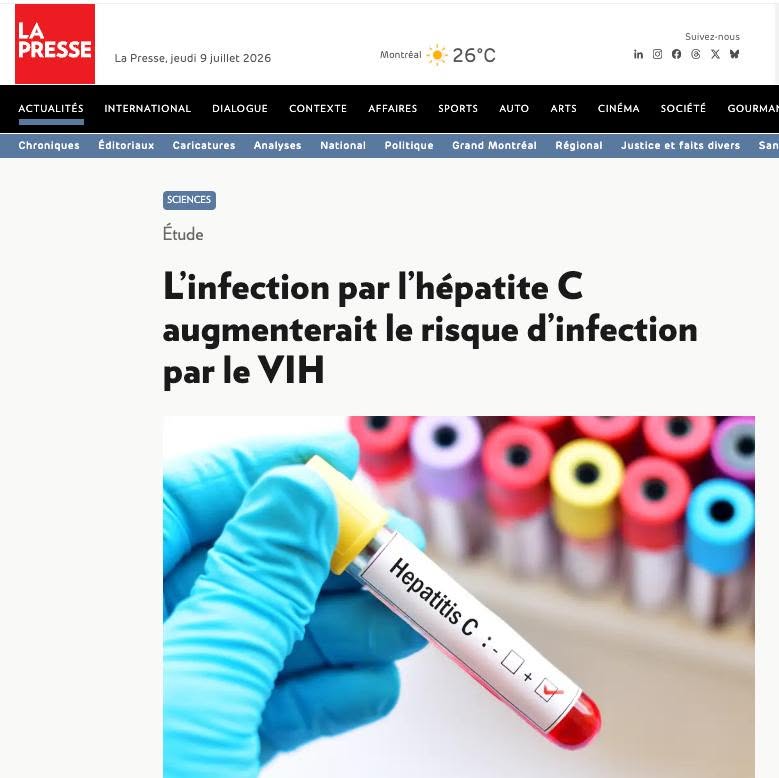
Sarah Champoux « Lutte contre l’hépatite C : les tests rapides réclamés par des intervenants ». La Presse, April 29, 2026. Read the article
Laurence Mersilian. « Le dépistage en milieu communautaire : une évidence pour enrayer l’hépatite C ». La Presse, April 29, 2026. Read the article

![web HEP C - Feuille de route du Quebec en matiere d elimination de l hepatite C[95]](https://capahc.com/wp-content/uploads/2026/07/web-HEP-C-Feuille-de-route-du-Quebec-en-matiere-d-elimination-de-l-hepatite-C95.webp)