Your reference for hepatitis C in Quebec

Provincial Committee
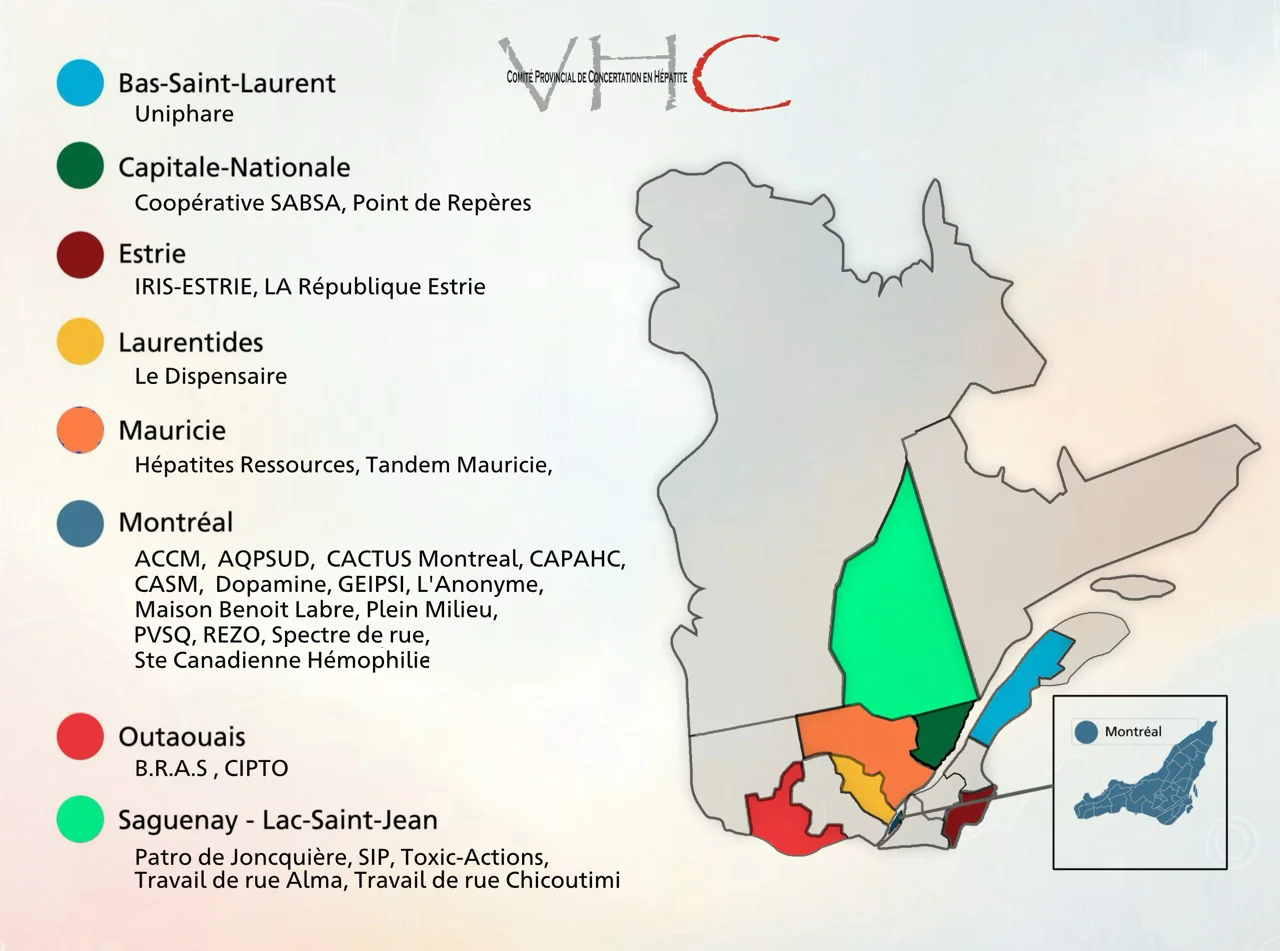
The purpose of the Comité provincial de concertation en hépatite C is to ensure that community organizations work together to publicize and recognize its recommendations on hepatitis C in Quebec, and thus encourage increased knowledge, harmonious policies and support for members in their actions.
Its philosophy is to place people at risk of or living with hepatitis C at the center of its efforts, with a focus on empowerment and harm reduction. It is composed of several organizations and groups working on hepatitis C in Quebec.
- Aids Community Care Montreal (ACCM) – Montréal
- Réplique Estrie
- L’Association Québécoise pour la promotion de la santé des personnes utilisatrices de drogues (AQPSUD)
- Bureau Régional d’Action Sida (BRAS) – Outaouais
- CACTUS – Montréal
- Centre Action Solidarité Montréal
- Centre d’Intervention et de Prévention en Toxicomanie de l’Outaouais (CIPTO)
- Coopérative de solidarité SABSA
- Le Dispensaire – St Jérôme
- Dopamine – Montréal
- GEIPSI – Montréal
- Hépatites Ressources – Trois-Rivières
- Intervention Régionale & Information sur le Sida (IRIS) – Estrie
- Le Patro de Jonquière
- Maison Benoit Labre
- Plein milieu – Montréal
- Portail VIH/SIDA du Québec
- Point de Repères – Québec
- REZO – Montréal
- Service d’Intervention de Proximité (SIP) Roberval
- Société canadienne de l’hémophilie – Montréal
- Spectre de rue – Montréal
- Tandem Mauricie
- Toxic-Actions – Lac-St-Jean
- Travail de rue d’Alma
- Travail de rue Chicoutimi
- Uniphare
- L’unité d’intervention mobile l’Anonyme – Montréal
The Committee supports the importance of rapid screening at the point of care, to effectively reach key populations.
He is advocating for community workers to be able to administer these tests in order to speed up care for people living with the hepatitis C virus (HCV) in Quebec. You can read the Open Letter: For More Accessible Hepatitis C Screening Here. In collaboration with the healthcare network, the Committee is working to achieve the WHO’s goal of eliminating hepatitis C by 2030. It encourages the implementation of innovative community-based programs that provide personalized support throughout the care continuum.